
TopicsLatest information
2026.01.09
Switching from Conventional Wires to FPCs (Part 2)
ColumnBy switching wiring materials from standard electric wires to FPCs (Flexible Printed Circuits), we can offer a variety of advantages.
According to last issue, we would like to explain; 5. Component Direct Mountable, 6. Improved Reliability and 7. Design Flexibility in this issue.
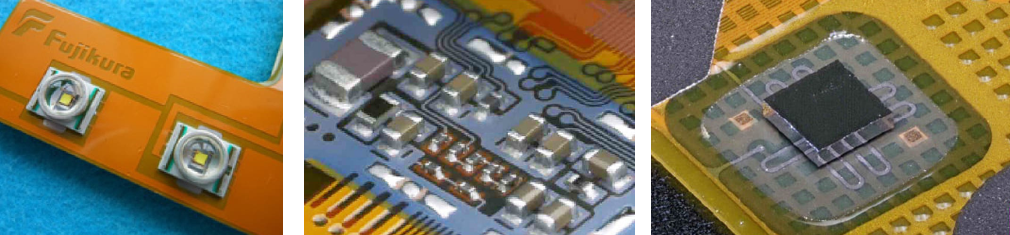
Component Direct Mountable
FPCs are a type of circuit board, allowing for direct component mounting. They are also heat-resistant for soldering, so there is no concern about sheath or insulation melting or burning as with wires. Furthermore, by forming mating terminals directly on the FPC, it is possible to connect to a rigid board using only a connector on the rigid board side, eliminating the need for connectors on both sides as with wires and reducing total cost.
Improved Reliability
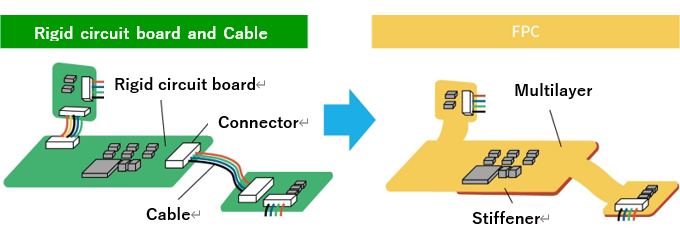
Where rigid boards were previously interconnected by wires (rigid board - wire - rigid board), FPCs can replace all wiring with a single flexible connection. This reduces not only total cost but also the number of connectors and solder points, which increases reliability, especially in environments exposed to constant vibration.
Design Flexibility
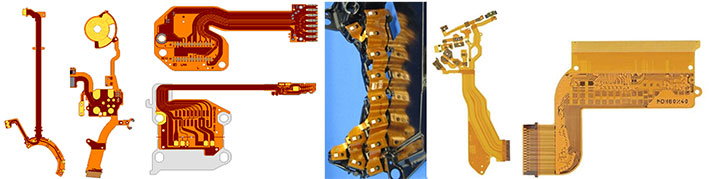
Electric wires are limited to standardized types, such as AWG, but FPCs can be tailored to customer requirements by selecting copper thickness, base film thickness, and custom shapes adapted to the product’s enclosure, making efficient use of available internal space.
Despite these many advantages, several aspects must also be considered. While they provide a high degree of design flexibility, they also increase costs related to custom design. Furthermore, since each FPC is custom-made, tooling (blanking dies and dedicated jigs) is required for each design, making them more expensive than wires in low volume production. In terms of EMI (electromagnetic interference), just as with shielded electric wires, FPCs require shielded design when necessary, and impedance control is also possible.
