
TopicsLatest information
2026.09.14
Introduction to FPC: Key Points for TH and LVH design - Part 3
ColumnAdvantages of LVH (Laser Via Hole)
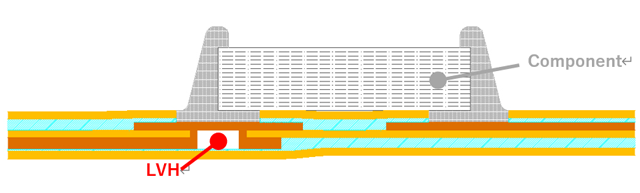
LVH most advantage is to achieve high-density routing through the use of smaller via and land diameters.
In addition, LVH offers another important benefit not available with traditional through-holes (TH).
Because LVH structures are non-through vias, the conductor layer at the via bottom can be utilized as a pad or component mounting land. This provides more flexibility in layout design.
Summary of TH and LVH Characteristics
The key features of TH and LVH are summarized as below table.
When designing actual products to order our FPC, please confirm to us about critical specifications.
| TH (Through Hole) | LVH (Laser Via Hole) | |
|---|---|---|
| Typical Hole Diameter | Φ0.15mm or larger | Approximately Φ0.1mm |
| Processing Method | Mechanical drilling → copper plating of drilled holes | Laser drilling → copper plating of micro vias |
| Durability of Bending area | High risk of open failure if placed in bend regions | Easier to avoid bend areas compared to TH, but plating reliability must be considered |
| Plating Reliability | Relatively stable, but depends on hole size and plating thickness | Requires careful control of via plating coverage and surface flatness; process control is critical |
| Cost & Lead Time | Generally lower cost thus, suitable for high-volume production | Higher unit cost and longer lead time than TH |
| Key Design Considerations | Avoid bend areas; confirm land shape and sufficient annular ring | Verify plating conditions (e.g., thickness) and pad design |
