
TopicsLatest information
2026.04.08
How Much Weight Reduction Can Be Achieved by Switching to FPC?
ColumnSwitching from Wires to FPC (Part 1) explained the concept. Here, we will show how much weight reduction can actually be achieved by using FPC.
For Wiring Materials Inside Electronic Devices
In electronic devices, wiring that requires impedance control often uses fine coaxial cables, commonly referred to as micro-coaxial cables. Among the widely used micro-coaxial cables, the thinnest is AWG46, with a cable diameter of 0.24mm.
When impedance-controlled structure and pattern design are applied to FPC, the thickness can be reduced to 0.16mm.
Assuming a transmission length of about 300mm and including necessary components such as connectors for board connection, the total weight is approximately **4g for a micro-coaxial cable assembly**, compared to **1.3g for an FPC assembly**.
By adopting FPC, the weight of the wiring components can be reduced to **one-third**.
This effect is particularly noticeable in applications such as drones and robots, where product weight directly impacts operating time.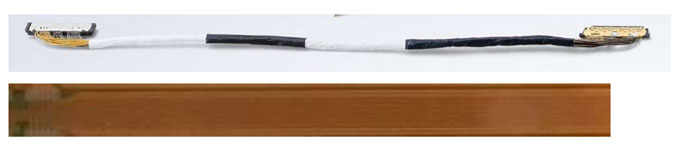
For Automotive Wiring Materials
Globally, the ratio of new vehicles that are BEVs (Battery Electric Vehicles) and PHEVs (Plug-in Hybrid Electric Vehicles) is increasing. These vehicles are primarily electric, and since vehicle weight directly affects driving range, reducing the weight of components is extremely important.
While this applies to all onboard electronic devices, special attention is given to wiring for monitoring large-capacity drive batteries.
For example, the weight of a typical battery monitoring wiring unit using automotive electronic wires in a BEV is about 960g.
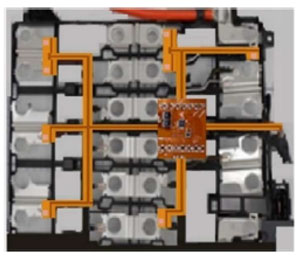
When replaced with an FPC-based unit, the weight drops to approximately 20g.
This means that compared to a wire-based unit, **weight can be reduced by about 98%。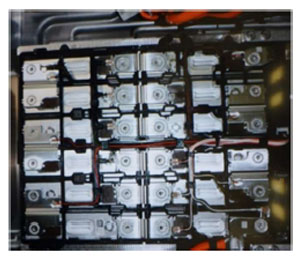
Actual BEV Drive Battery Unit
Cable weight of BMS:960gSchematic Diagram of BMS Wiring Converted to FPC
Expected weight:18.4g
#FPC # Electronic wire #My first FPC #weight reduction
