
TopicsLatest information
2026.05.18
Introduction to FPC Design : Key Points for Defining the “Flexible” and “Rigid” Sections in FPC Design – Part 2
ColumnContinuing from the previous explanation about the flexible section, this document discusses important points regarding the rigid section and the boundary between the two.
Understanding the Rigid Section (Non-Bending Area)
Role of the Rigid Section
- Component mounting area for ICs, connectors, resistors, and capacitors
- Ensures soldering and assembly reliability
- Adjust thickness for connector mating areas
How to Provide Rigidity
Rigidity is achieved by attaching a stiffener. Polyimide is the most used material, though glass epoxy* (CEM-3, FR-4) or metal plate may also be used depending on requirements.
* : glass epoxy is a glass fiber–reinforced plastic (GFRP) made by impregnating glass fiber (glass cloth) with epoxy resin and then thermosetting it into a laminated composite.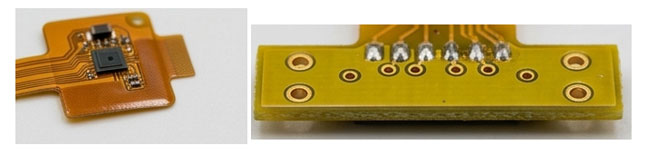
-
The Boundary Between Flexible and Rigid Sections Is Critical
Typical Design Mistakes
- Placing components too close to the boundary
- Changing trace width (wider/narrower) across the boundary
- Locating a coverlay opening* edge near the boundary (e.g., at connector mating areas)
* : A coverlay opening refers to a cut-out hole in the FPC’s protective film (coverlay) that exposes the copper traces in areas where soldering is required, such as component mounting pads or connector terminals.
Recommended Design Practices
- Consult us regarding appropriate component clearance from the boundary
- When changing trace width, keep the transition entirely within the rigid section
- Consult us about necessary spacing between the rigid/flexible boundary and coverlay opening edges
-
Information That Must Be Clearly Defined in Drawings and Data
To help prevent design-derived issues, please provide the following information when submitting data.
For Flexible Sections
- Definition of flexible areas (including areas where component placement or through-holes are prohibited)
- Bending direction, if applicable
- Type of bending - static or dynamic - and the bending radius, if applicable
For Rigid Sections
- Definition of rigid areas (including stiffener attachment zones)
- Material and thickness specifications of the stiffener used for rigidity
Careful attention to these points during design will greatly help prevent issues and ensure stable performance.
If you have any questions or concerns, please consult with us during your design process.
#FPC #My first FPC #FPC design #Flexible area #Rigid area #Stiffener
